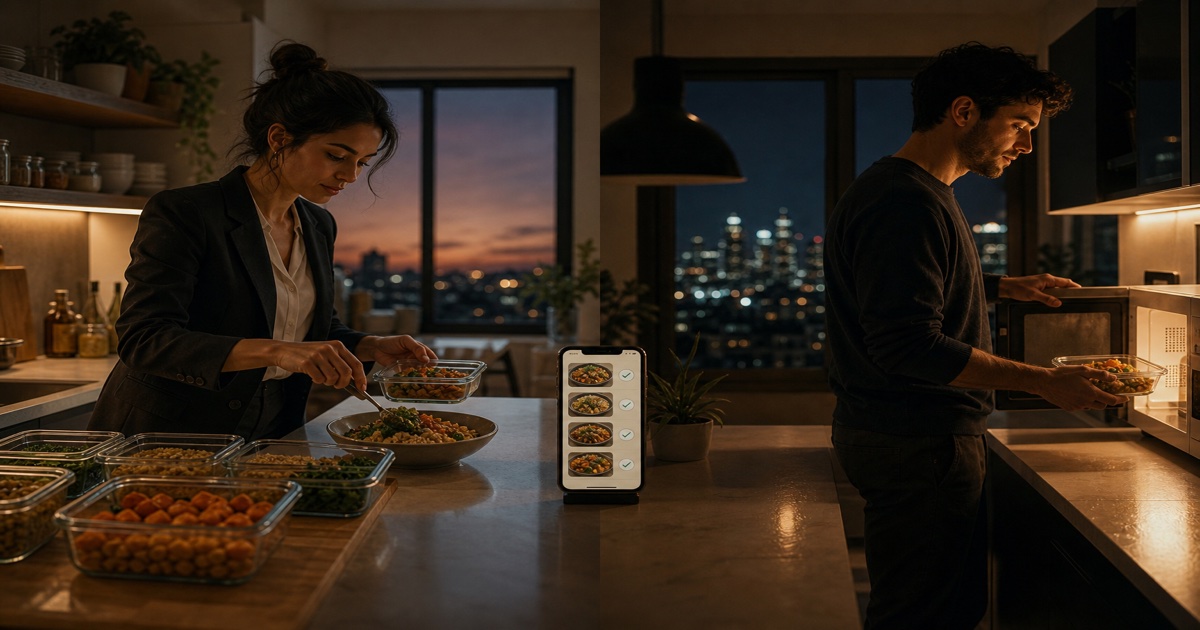
One of you works 7am–3pm. The other closes the restaurant at 11pm. Or it's nurse shifts, rotating on-call weeks, and the classic "I'm starving at 6, you're not hungry until 9." You love each other. You still end up cooking twice—or eating cereal over the sink alone.
Meal prep for couples with different schedules is not about eating dinner together every night. It's about cooking once, storing food that reheats well, and letting each person eat when they're actually hungry—without a second round of pots and pans at 10pm.
This is the buffet-component system shift workers and mismatched nine-to-fivers use to stay fed without nagging each other about timing.
It's a timing problem, not a food problem
Most couple meal advice assumes you sit down at 6:30pm together. Real households don't look like that:
- Shift work: One partner eats before the shift; the other eats after midnight.
- Late-office culture: Dinner at 6 for one, 9 for the other—same apartment, different time zones.
- Split custody of the kitchen: Whoever gets home first is supposed to cook, but "first" changes daily.
When schedules don't overlap, the failure mode is always the same: food made for two at one time goes cold, gets microwaved to rubber, or someone cooks again from scratch. Resentment follows—not because the meals are bad, but because someone is always eating leftovers of a moment that already passed.
The fix is structural: prep for staggered eating, not synchronized dining.
Prep once, assemble separately
Sunday (or whichever day you share) is the only heavy cooking session. Both partners participate if possible—chop together, split oven and stovetop, finish in under two hours.
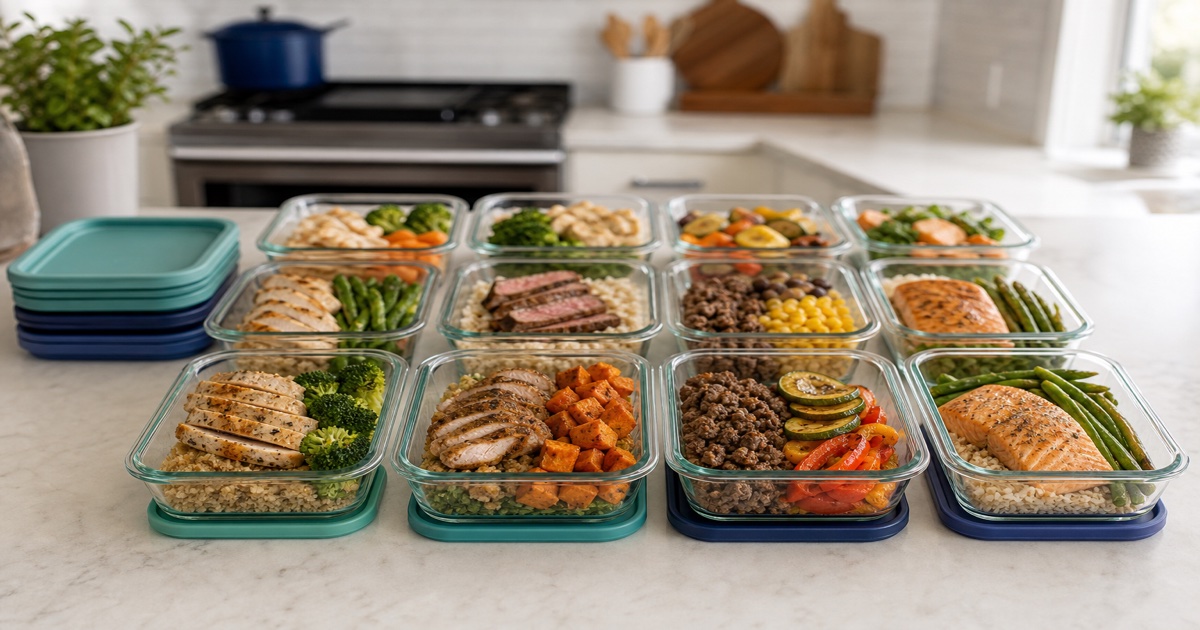
After prep, you do not plate couple dinners. You stock the fridge like a small, healthy buffet:
- Proteins in single- or double-serving containers
- Grains and starches portioned separately
- Vegetables that reheat well (and some raw crunch kept apart)
- Sauces in squeeze bottles or small jars
Partner A eats at 5:30pm Tuesday: reheat one chicken portion, scoop rice, add cold slaw and sauce. Partner B eats at 10pm: same components, different combination—maybe a wrap instead of a bowl. Same prep. Zero re-cooking.
This mirrors the modular approach in meal planning for two—but optimized for time, not taste conflicts.
Buffet components that survive staggered eating
Choose components that reheat evenly and combine multiple ways:
| Component | Why it works | Reheat tip |
|---|---|---|
| Roasted chicken thighs | Stay moist; slice cold for wraps | 90 sec covered in microwave; splash of water |
| Seasoned ground turkey or beef | Fast skillet reheat | Low heat with splash of broth |
| Firm tofu, pressed and baked | Good hot or cold | Crisp in air fryer 3 min if available |
| Rice or quinoa | Neutral base | Microwave with damp paper towel |
| Roasted root veg and broccoli | Better day 2–3 | High heat 5 min to re-crisp |
| Slaw mix (undressed) | Stays fresh all week | Add dressing only at assembly |
| Eggs (hard-boiled) | No reheat needed | Grab and go |
Avoid pre-dressing salads, pre-sauced noodles, and bread-heavy preps—they degrade fast when eaten hours apart.
Shared meal pool, not day assignments
Do not label containers "Monday dinner." Shift schedules change. Labels become lies by Wednesday.
Instead, maintain a shared meal pool—four to five options both partners pull from freely:
- Chicken + rice + chimichurri bowl
- Turkey + slaw + tortilla wrap
- Tofu + veg + peanut sauce over rice
- Big salad + egg + cold chicken
- Backup: frozen dumplings + bagged greens
Post a simple list on the fridge or in your shared app: "This week's pool." Each person eats what they want, when they want. Track what's left so nobody assumes the last chicken portion is "theirs."
ChefSphere's meal prep workflow supports this: tag meals as pool items, not calendar-locked dinners, and both partners see what's remaining in real time.
Reheat packaging that actually works
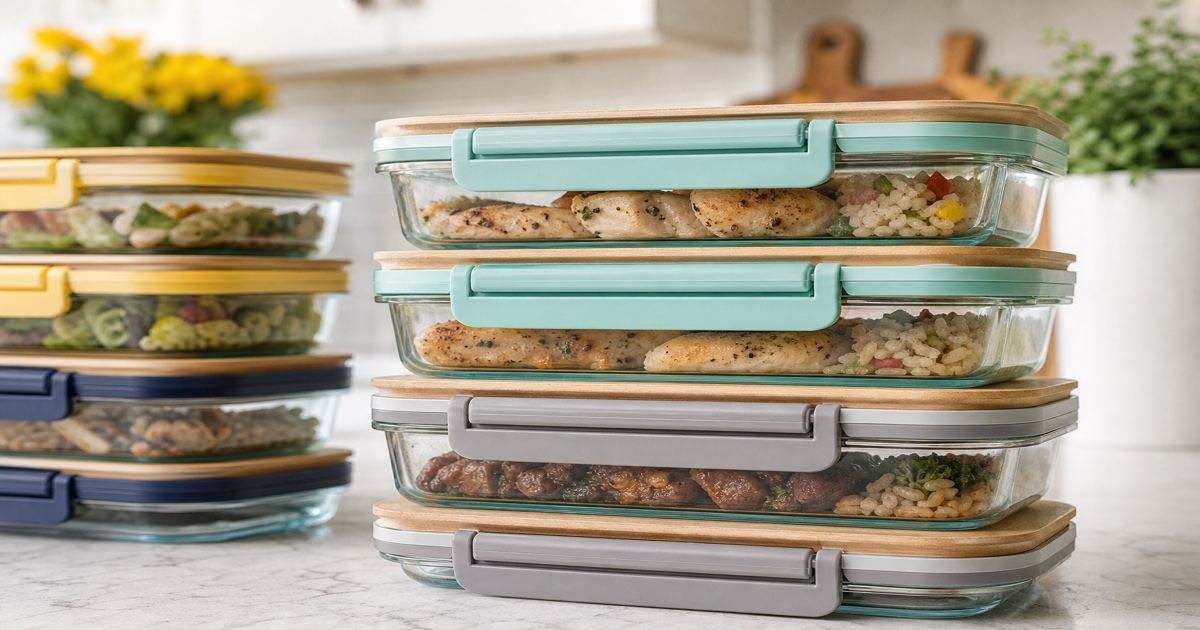
Staggered eating lives or dies on container strategy:
- Separate wet and dry. Sauce never lives on rice until assembly.
- Single-serving portions. Reheating one person's meal shouldn't steam the whole batch.
- Glass or high-quality BPA-free. Plastic picks up smells; glass reheats more evenly.
- Uniform sizes. Stackable containers fit more in a couple-sized fridge.
- Label protein + date only. Skip day names; use "chicken, Jun 8" instead.
For the partner eating at midnight: leave a designated shelf—front and center, no digging. Small kindness, large friction reduction.
The 15-minute recovery meal
Some nights a component bowl isn't happening—exhaustion, emotional spillover, empty pool. Every staggered-schedule couple needs a 15-minute recovery meal that either partner can execute half-asleep:
- Frozen dumplings + frozen veg + soy-ginger splash
- Canned chickpeas + jarred curry simmered + microwave rice
- Eggs scrambled with whatever veg is left + toast
- Rotisserie chicken (backup buy) + bagged salad + bottled dressing
Pre-decide yours. Write it on the fridge below the meal pool. Recovery meals prevent the 10pm from-scratch cook that burns out the late-shift partner every time.
Coordinating without nagging
Staggered schedules create invisible labor: Who prepped? Who ate the last portion? Who forgot to shop?
Replace verbal reminders with visible systems:
- One shared list for the meal pool—check off components as they're used.
- One prep owner per week—alternate Sundays so prep labor doesn't stick to one person.
- "I'm eating out" flags — Mark nights one partner won't touch the pool so portions stretch for the other.
- Low-stock alert — When two portions remain, either person shops or you activate backup.
ChefSphere Couple Zone makes assignments and pool status visible to both partners—replacing "did you eat my lunch?" with a shared screen.
Sample week: opposite schedules in practice
The couple: Partner A — hospital shifts (7am–7pm Tue/Thu, off Wed/Fri). Partner B — remote, eats 12:30 lunch, 7pm dinner.
Sunday prep (shared, 2 hours):
- Roast 10 chicken thighs (more portions for staggered eating)
- Cook 4 cups dry rice
- Roast two veg trays (broccoli/peppers + sweet potato)
- Chimichurri + lime-yogurt sauce
- Hard-boil 10 eggs
- Portion into single- and double-serving containers
How the week actually flows:
| Day | Partner A (shift) | Partner B (remote) |
|---|---|---|
| Mon | Bowl before shift (5:30am prep from pool) | Wrap at lunch; bowl at 7pm |
| Tue | Eats at hospital | Uses pool at 7pm; leaves 2 portions for A's late return |
| Wed | Off — shared dinner: assemble together, 6pm | Same |
| Thu | Shift — grabs wrap + eggs from pool | Salad + chicken at lunch |
| Fri | Late shift — recovery dumplings at 11pm | Bowl at 7pm |
| Sat | Shared brunch from pool + fresh fruit | Same |
Notice: only one rigid shared dinner (Wednesday). The pool carries everything else. Saturday brunch is the second anchor. Flexibility is the system.
Protect two to three "eat together" nights
Different schedules don't mean never eating together. Research on relationship satisfaction consistently points to shared meals as connection time—not because of the food, but because of uninterrupted presence.
Protect two to three anchor nights per week, even if:
- The meal is simple assembly from the same pool
- One partner eats lightly before and joins with tea while the other eats full portions
- You eat at 8:30 instead of 6 because that's when you overlap
Put anchor nights on the calendar like meetings. Non-negotiable unless travel or emergency. The pool makes these nights low-effort—you're assembling together, not cooking under pressure.
Browse recipes built for modular assembly, or let AI suggest anchor-night combos that use what's already prepped.
How ChefSphere handles two calendars
Manual buffet prep works until shifts rotate. ChefSphere automates the coordination:
- Dual calendars — Each partner's work pattern informs prep quantities (more portions on shift days).
- Pool-based plans — The AI meal planner generates buffet components, not locked nightly dinners.
- Shared grocery list — One shop, sized for staggered consumption across the week.
- Usage tracking — See what's left in the pool; get nudges before you run out mid-shift.
- Anchor night suggestions — AI finds overlap windows and proposes low-effort shared meals.
Premium includes a free partner account—critical for shift couples who rarely prep at the same time but need the same source of truth.


