You get home at 6:45pm. You're hungry, tired, and the fridge has ingredients—but no plan. Your partner asks what's for dinner. Twenty minutes disappear into "I don't know, what do you want?" and you order delivery again. Sound familiar?
Weekly meal prep for two is not about spending Sunday afternoon plating five identical Tupperware dinners. Busy couples need a component system: batch the building blocks once, assemble fresh on weeknights in under twenty minutes, and stop negotiating dinner when both of you are already depleted.
This is the two-hour Sunday framework working couples use to cover five weeknight dinners without cooking every night.
Why family meal prep fails for couples
Most meal prep content is written for a family of four or a solo fitness bro. Couples sit in an awkward middle: recipes serve four, grocery packs are sized for households, and "prep five dinners" often means five identical plates that someone is sick of by Wednesday.
The failure modes are predictable:
- Over-prepping: You cook seven full meals, eat three, and bin the rest.
- Under-prepping: You chop one salad and call it prep; Thursday still ends at the delivery app.
- Mismatched hunger: One partner wants a light bowl; the other wants a full plate—pre-portioned meals can't flex.
- Schedule drift: A late meeting on Tuesday means Monday's pre-plated stir-fry sits untouched while you scramble.
The fix is not more discipline. It is a system sized for two eaters, five flexible nights, and one grocery run.
Prep components, not meals
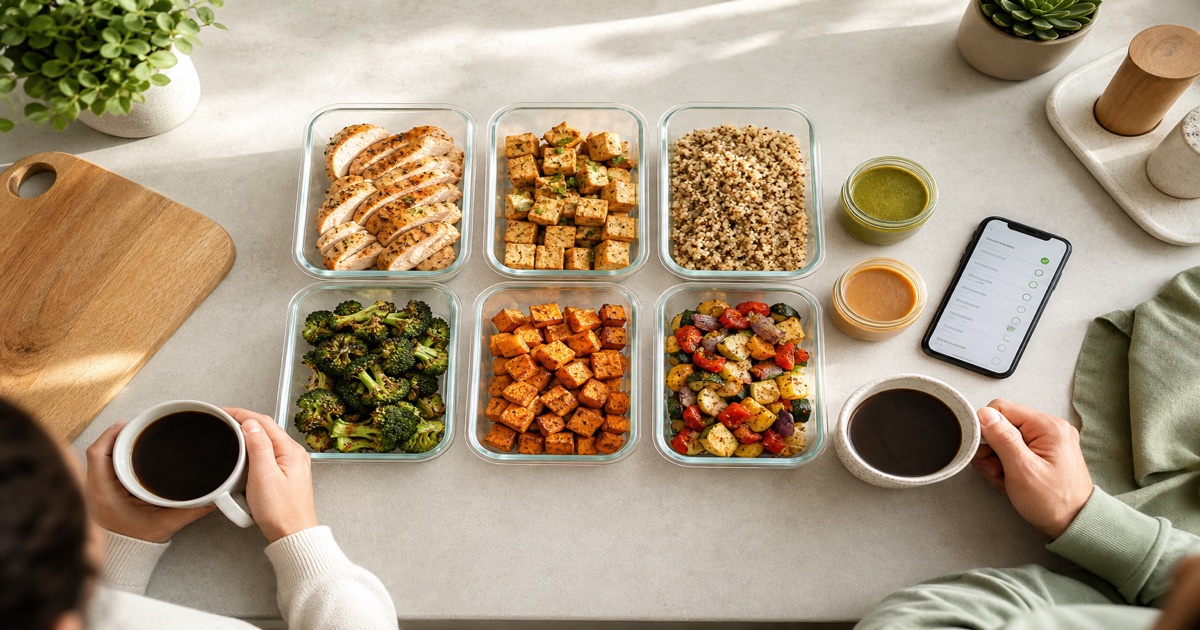
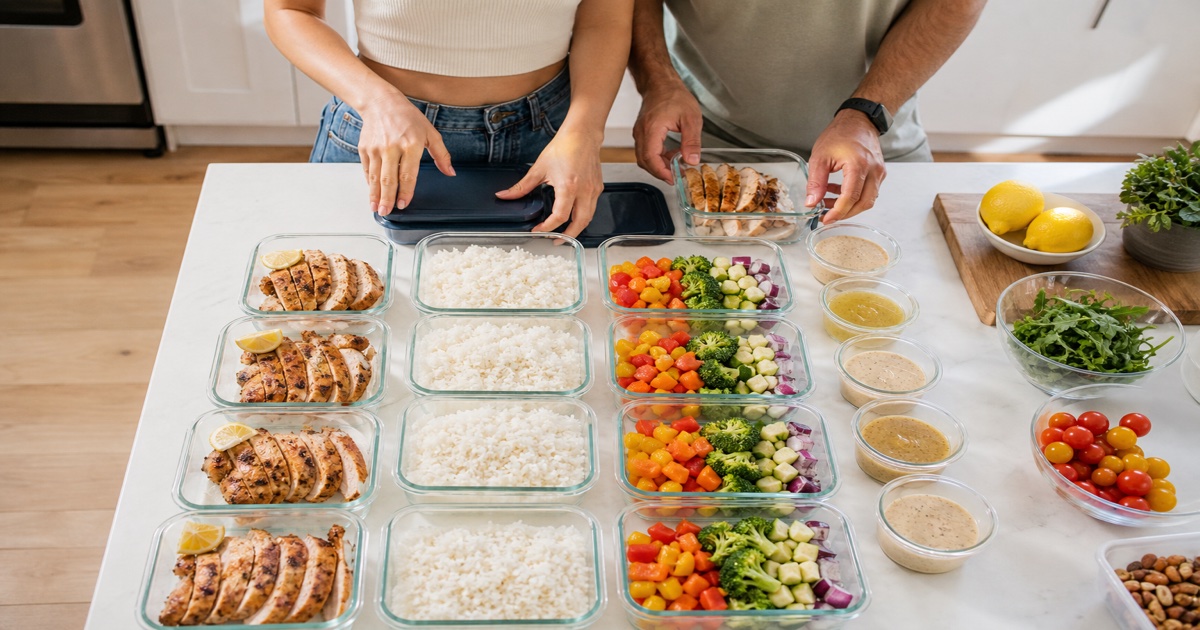
The highest-leverage shift for couples: stop plating dinners on Sunday. Batch components instead:
| Component type | Examples | Used in |
|---|---|---|
| Protein anchor | Roasted chicken thighs, seasoned ground turkey, baked tofu, hard-boiled eggs | Bowls, wraps, skillets, salads |
| Grain or starch base | Rice, quinoa, roasted potatoes, whole-wheat pasta (cooked al dente) | Bowls, stir-fry, pasta night |
| Vegetable tray | Roasted broccoli and peppers, sautéed spinach, shaved slaw mix | Everything |
| Sauce or dressing | Chimichurri, tahini-lemon, salsa verde, peanut-lime | Flavor carrier—keeps prep from tasting same-y |
| Fresh crunch | Pre-washed greens, cucumber, herbs, lime | Added at assembly so nothing wilts |
You cook once. On Tuesday you might build grain bowls; on Thursday you might throw the same chicken into wraps with different sauce. Same prep, different dinners.
This is the same modular logic as meal planning for two—shared base, flexible assembly—applied to Sunday batching.
Four to five dinner skeletons (not seven recipes)
You do not need seven unique dinners. You need four to five skeletons—meal shapes that repeat with swapped components:
- Grain bowl night — base + protein + veg + sauce
- Wrap or taco night — protein + slaw + sauce in a tortilla
- Skillet night — protein + veg + starch in one pan, 10 minutes
- Pasta or noodle night — cooked pasta + sauce + protein add-in
- Big salad night — greens + protein + crunchy toppings + dressing
Pick your skeletons once. Rotate the proteins and sauces every week. Variety comes from combinations, not from cooking seven separate entrees on Sunday.
The two-hour Sunday timeline
Set a timer. Parallel work is everything.
0:00–0:15 — Setup and oven on
- Clear counter space and lay out containers.
- Preheat oven to 425°F (220°C).
- Start rice or quinoa on the stove (or in a rice cooker).
- Put chicken thighs or a sheet-pan protein in the oven.
0:15–0:45 — Stovetop and second tray
- While the oven runs, chop all vegetables in one pass—one cutting board, one knife, one pile for roasting, one for slaw.
- Start ground turkey or tofu in a skillet if using.
- Put a second tray of vegetables in the oven when the first is halfway done.
- Hard-boil eggs if they're part of your week.
0:45–1:15 — Sauces and cooling
- Blend or whisk two sauces—they carry the whole week.
- Pull proteins and veg from oven; let them cool slightly before boxing.
- Fluff grains and divide into containers.
1:15–1:45 — Portion, label, fridge
- Portion proteins into two-serving units where possible—you'll often eat the same protein two nights in a row with different skeletons.
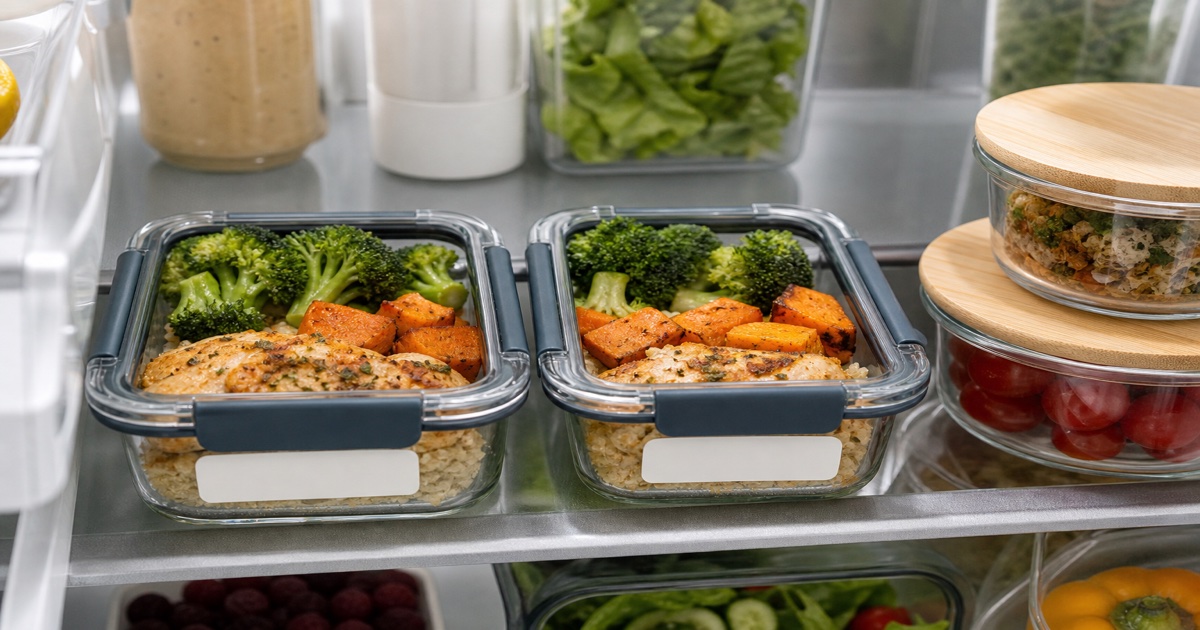
- Label every container: contents + date.
- Stack fridge logically: proteins middle shelf, veg below, sauces up front.
1:45–2:00 — Backup check and list for next week
- Confirm your backup meal is stocked (see below).
- Note anything that ran out last week. Adjust next grocery list.
Two hours. Five weeknight dinners handled.
One grocery list, one shop
Couples waste money when two people shop from memory. Build one aggregated list from your skeletons and component quantities:
Proteins (pick 2–3):
- 1.2–1.5 kg chicken thighs or 750g ground turkey + 400g firm tofu
- 12 eggs (breakfast backup + bowl topping)
Grains and starches:
- 500g rice or quinoa
- 1 package tortillas or wraps
- 400g pasta (optional skeleton)
Vegetables (overlap across skeletons):
- 2 heads broccoli or 1 kg mixed peppers/onion
- 200g spinach or kale
- 1 cucumber, 1 lime, fresh herbs
- Bag of salad greens
Pantry and sauces:
- Olive oil, garlic, ginger, soy or tamari
- Greek yogurt or tahini for dressings
- Canned beans (backup + bowl topping)
- Salsa, hot sauce, spices you actually use
Shop once. If you use ChefSphere's meal prep workflow, the AI aggregates quantities across your skeletons and outputs one list—no spreadsheet math.
Weeknight assembly: under 20 minutes
Weeknights are assembly, not cooking. The rule: nothing should take more than twenty minutes from fridge to table.
Monday — Grain bowls (12 min): Reheat rice and chicken. Top with roasted veg and slaw. Drizzle sauce. Done.
Tuesday — Wraps (10 min): Warm turkey or tofu. Fill tortillas with slaw, protein, sauce. No stove required.
Wednesday — Skillet (15 min): One pan: protein + veg + a handful of rice. High heat, splash of sauce.
Thursday — Pasta (18 min): Boil fresh water for pasta if not pre-cooked, or reheat pre-cooked pasta with sauce and protein.
Friday — Big salad (8 min): Greens, cold protein, crunchy veg, dressing. Lowest effort night—save it for when you're most tired.
Whoever gets home first can start reheating. The second person assembles. No debate required.
The backup meal rule
Every couple needs one pre-decided backup that requires zero prep and zero debate:
- Canned bean quesadillas with freezer tortillas
- Frozen dumplings + bagged salad
- Rotisserie chicken + bread + whatever veg is left
- Eggs + frozen stir-fry veg + rice from the batch
When the plan collapses—late work, surprise guests, emotional exhaustion—the backup activates. No negotiation. No delivery app spiral. Write it on the fridge: "If we can't assemble, we eat X."
Storage and portioning for two
Food safety and sanity rules for two-person prep:
- Fridge window: Most cooked proteins and grains last 3–4 days. Prep Sunday; eat through Wednesday from fridge; use fresher assembly or freezer portions Thu–Fri.
- Portion for two: Store in containers sized for one dinner for two, not one person—reduces the "who ate my lunch" problem.
- Sauce separate: Always. Wet components soggy by day three.
- Freeze extras: If you batch 1.5 kg chicken, freeze one two-serving portion for Thursday.
- Label dates: Your future self will not remember which container is Monday.
Four-week rotation (so you don't quit)
Boredom kills meal prep. Rotate proteins and sauces, not the system:
| Week | Protein focus | Sauce theme | Skeleton emphasis |
|---|---|---|---|
| 1 | Chicken thighs | Chimichurri + lime | Bowls and wraps |
| 2 | Ground turkey | Peanut-lime + salsa | Tacos and skillets |
| 3 | Tofu + eggs | Tahini-lemon + harissa | Salads and bowls |
| 4 | Salmon or canned fish | Yogurt-dill + mustard | Pasta and big salads |
Same two-hour session. Different flavors. After four weeks, loop back to week one—it'll feel new again.
Browse recipes for component-friendly ideas, or let the AI rotate for you.
How ChefSphere AI fits in
Manual meal prep works until life gets busy. ChefSphere automates the parts couples actually struggle with:
- Merged preferences — Both partners swipe independently; the AI finds overlap and builds a prep plan both will eat. See meal planning for two.
- Component-aware plans — The AI meal planner generates skeletons and reuses ingredients across the week—one chicken batch, three dinner shapes.
- One aggregated grocery list — Quantities calculated for two servings, organized for one shop.
- Couple Zone assignments — Who preps Sunday, who assembles which night—visible, not argued.
- Backup meal slot — Tag one night as "flex/rescue" so the plan survives reality.
Premium includes a free partner account—both of you see the same prep plan and grocery list in real time.
Sample week: two busy professionals
Sunday (2 hours): Roast 8 chicken thighs. Cook 3 cups dry rice. Roast two trays of broccoli and peppers. Make chimichurri and a lime-yogurt sauce. Hard-boil 8 eggs. Portion and label.
Monday: Chicken bowls — rice, chicken, roasted veg, chimichurri. (12 min)
Tuesday: Chicken wraps — sliced chicken, slaw mix, yogurt sauce. (10 min)
Wednesday: Skillet fried rice — rice, egg, leftover veg, soy. (15 min)
Thursday: Chimichurri chicken salad — greens, cold chicken, cucumber, sauce. (8 min)
Friday: Backup — bean quesadillas because Partner A has a late call. (10 min)
Lunches: Leftover components or eggs + slaw. No extra cooking.
Total active cooking after Sunday: under one hour for the whole week.


