“AI meal planning” sounds like a black box that reads your mind. In production systems—ChefSphere included—it is closer to constraint satisfaction plus preference learning: you supply boundaries (time, budget, diet, household), you generate candidate meals, and you refine with feedback. In April 2026, the products that win are not the most magical; they are the ones that reduce weekly failure modes: empty calories of planning, duplicated shopping, and plans that ignore real life.
The five inputs that separate good plans from fantasy
- Hard constraints: allergies, medical diet requirements, non-negotiable exclusions.
- Soft preferences: cuisines, spice level, effort budget, cooking skill.
- Calendar reality: how many nights you truly cook vs assemble leftovers.
- Economic reality: weekly food budget and store access.
- Household reality: partners, kids, roommates—who eats what, and who cooks.
If an app ignores #5, you get beautiful plans nobody executes. Most "AI meal planners" in 2026 are actually single-user recipe generators with a weekly view. That is not meal planning — that is a recipe list with dates.
How AI meal planning is different from a recipe generator
| Feature | Recipe generator | AI meal planner |
|---|---|---|
| Output | List of recipes | Coordinated weekly plan |
| Grocery | Manual or per-recipe | Aggregated across all meals |
| Household | Single user | Multiple profiles, merged preferences |
| Budget | Ignored | Optimized with real prices |
| Health | Calorie count (maybe) | Multi-dimensional feedback loop |
| Adaptation | Static after generation | Adjusts weekly based on behavior |
ChefSphere operates at the planner level, not the generator level. The AI does not just pick recipes — it orchestrates a week that satisfies constraints, maximizes nutrition, minimizes grocery cost, and adapts to what actually happened last week.
Explicit preferences vs learned preferences
Explicit preferences are what you type in onboarding: "no cilantro," "Mediterranean-ish," "30 minutes max." Learned preferences come from behavior: saves, skips, substitutions, repeated choices.
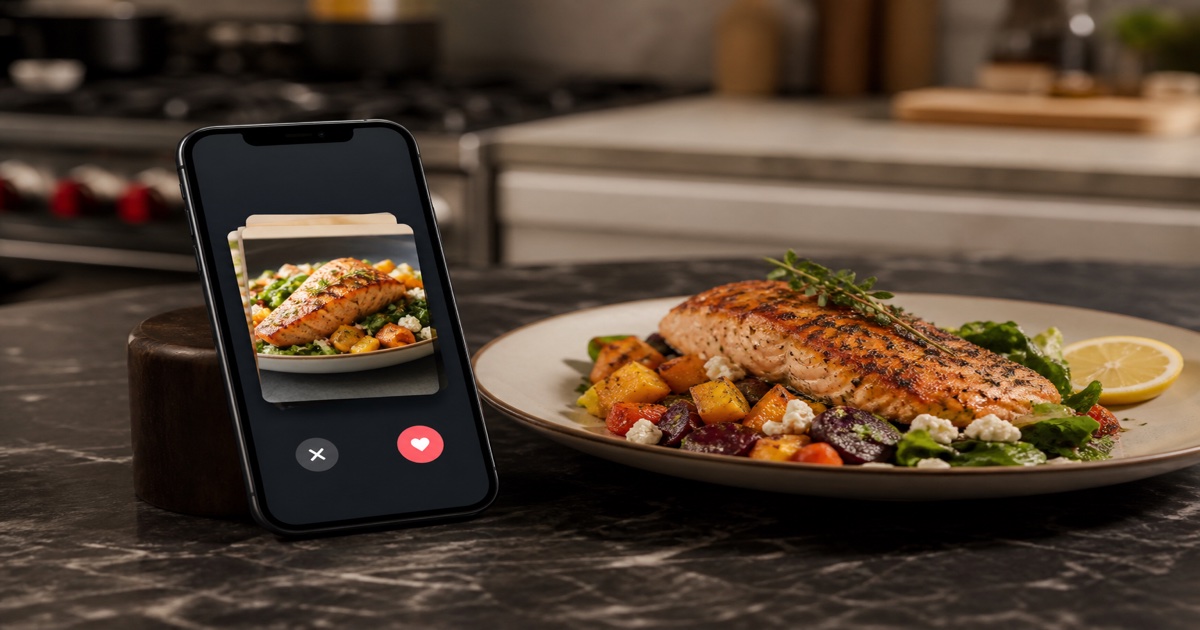
ChefSphere combines onboarding signals with interaction history—especially Swipe for Meals—so the system does not rely on a single static form you filled once in January.
The 50+ taste characteristics
Every swipe teaches the AI about your taste across dimensions most people cannot articulate:
- Protein preferences: Which meats, fish, plant proteins do you consistently accept?
- Cuisine tolerance: Mediterranean, Asian, Latin, Middle Eastern, comfort food — what is your real range?
- Effort ceiling: Do you swipe right on 45-minute recipes or only 15-minute ones?
- Spice profile: Mild, medium, hot — and which types of heat (chili, pepper, wasabi)?
- Ingredient patterns: Do you gravitate toward avocado, chickpeas, or cheese in every bowl?
- Complexity tolerance: Simple 5-ingredient meals or elaborate multi-technique dishes?
After 50–100 swipes, the AI has a richer taste profile than you could write in a survey.
What swipe actually trains
Swipe interactions are not "gamification." They are fast labeled examples of taste. The failure mode of classic apps is a cold start: you scroll forever. Swipe compresses exploration into a signal the planner can use: what proteins, cuisines, and effort levels you tolerate when you are hungry and honest.
This data feeds directly into plan generation. When the AI picks Thursday's dinner, it is not random — it is drawn from the intersection of your taste profile, your partner's profile (if in Couple Zone), your nutritional targets, and your budget.
Optimization: meals are not "generated from nothing"
Practical planners assemble from recipe pools and rules: nutrition targets, ingredient overlap for grocery efficiency, variety constraints (you do not want chicken five nights unless you asked for it), and substitution paths when an item is unavailable.
Ingredient reuse: the invisible optimization
One of the most impactful optimizations is ingredient reuse across the week:
- Buy one whole chicken → roast Monday → chicken salad Wednesday → chicken soup Friday
- Buy one bunch of cilantro → tacos Tuesday → grain bowl Thursday → Thai curry Saturday
- Buy one block of feta → salad Monday → stuffed peppers Wednesday → frittata Sunday
This reduces grocery cost, minimizes waste, and makes the plan feel intentional. The AI does this automatically — no manual spreadsheet required.
That is why grocery list generation matters: the plan is not a PDF—it is a contract with your shopping trip.
Budget optimization with real prices
Most meal planners ignore cost entirely. ChefSphere integrates Community Prices — crowd-sourced grocery prices from real shoppers at real stores — so the AI can:
- Generate plans within your weekly budget
- Choose cheaper proteins when beef prices spike
- Suggest store alternatives when one retailer is cheaper for your plan
- Show estimated weekly cost before you shop
The BLS reports food-at-home prices up 1.9% year-over-year through March 2026. Every dollar of planning efficiency compounds.
Feedback loops: health, sleep, workouts
If your product ignores physiology, you get plans that look correct and feel wrong. ChefSphere's Health Tracking Suite monitors four dimensions:
| Dimension | What it tracks | How it adjusts plans |
|---|---|---|
| Nutrition | Macros + micros per meal | Fills gaps — low on iron? More spinach and red meat next week |
| Water | Daily intake with goals | Suggests water-rich foods when hydration dips |
| Sleep | Quality and duration | Lighter dinners after poor sleep, earlier meal timing |
| Workouts | Type, intensity, duration | More protein on training days, fewer calories on rest days |
This is the feedback loop that competitors do not have: health data → plan adjustment → better outcomes → more data. Static plans cannot do this.
Vision AI: the "what's in my kitchen" layer
Text-only planning assumes you already know inventory. ChefSphere AI adds vision-assisted reasoning: photos of fridge or ingredients become constraints—"cook from what exists"—which reduces waste and last-minute delivery orders.
At CES 2026, GE launched a $4,899 smart fridge with barcode scanning. ChefSphere does the same thing with your phone camera — and handles loose produce, bulk items, and leftovers that barcodes miss. Read the full comparison.
Quick Recipe modes: when the plan breaks
Plans break. Life happens. Quick Recipe modes are the safety net:
- From pantry: Scan what you have, get a meal now
- From grocery list: Build around what you are about to buy
- Under 15 minutes: Fast meals when time collapses
- By ingredient: Start from that one thing you need to use before it expires
These are not separate from the planner — they feed back into it. A Quick Recipe on Wednesday becomes data that improves next week's plan.
What AI meal planning is not
- It is not medical diagnosis. The AI does not prescribe treatment.
- It is not guaranteed weight loss. Results depend on adherence and individual physiology.
- It is not perfect portioning without user honesty. Garbage in, garbage out.
- It is not a replacement for cooking. You still hold the knife.


