Most couples do not fight about food because they dislike each other. They fight because the work is invisible. One person feels like they always cook; the other feels like they always shop, or always clean. Nobody is keeping accurate records, so both keep emotional ones—and emotional ledgers are always biased toward "I do more."
The fix is not a chore chart taped to the fridge. It is a small, shared system that makes the work visible and the defaults automatic.
Why "we'll just figure it out" fails
Open-ended cooking arrangements collapse under stress. On a normal Tuesday, "whoever gets home first cooks" works. On a hard Tuesday—late meeting, bad mood, empty fridge—it turns into a standoff at 8pm with both of you scrolling delivery apps. The system has to hold on the bad days, not just the easy ones.
Step 1: Separate the three jobs
Cooking is really three jobs: deciding what to eat, shopping for it, and making it. Couples who split fairly almost never split all three evenly—they trade. One partner owns the plan and the list; the other owns more cooking nights. Or one shops every week; the other cooks four nights to the shopper's three. Name the three jobs out loud and the trade becomes obvious.
Step 2: Use a rotation, not a debate
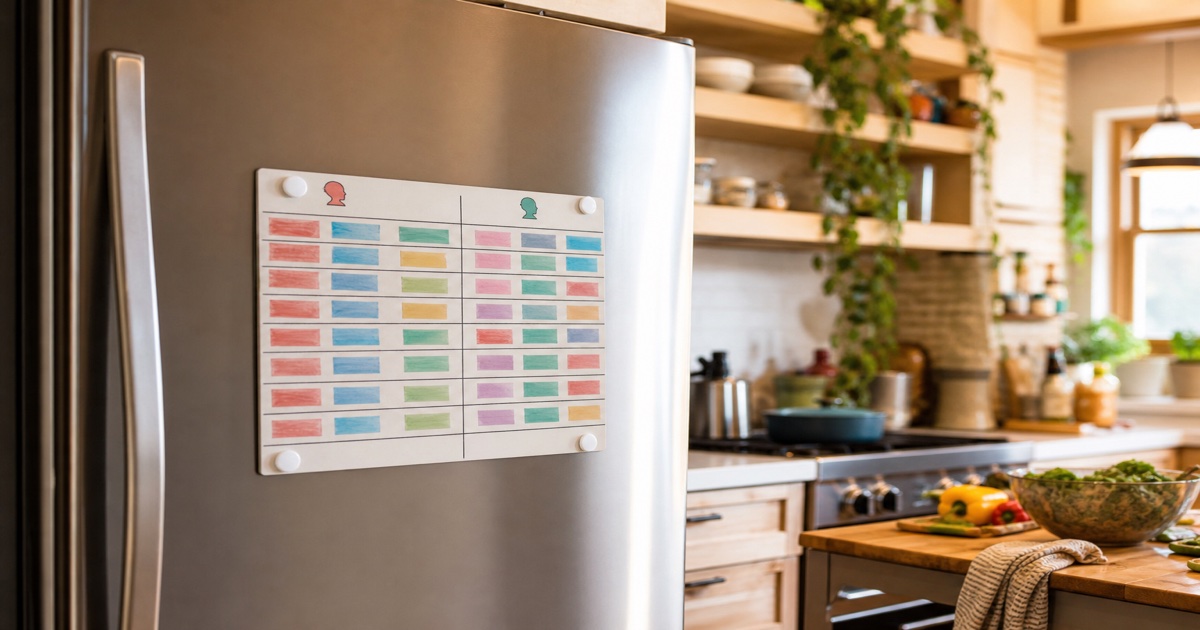
Assign cooking nights in advance. A simple weekly rotation—three nights each, one shared "cook together" night—removes the nightly negotiation. The point is to make the default planned instead of debated, so hunger never gets a vote.
This is exactly what ChefSphere's Couple Zone is built around: a dedicated cooking schedule that assigns each meal to a partner, tracks completion, and shows per-partner statistics. When cooking is tracked the same way a calendar tracks meetings, "whose turn is it?" becomes a data question instead of an argument.

Step 3: Keep assembly nights for the tired cook
Fairness is not about identical effort—it is about reliable effort. Give the less-confident or more-exhausted partner assembly nights: grain bowls, wraps, a good salad, a sheet-pan dinner. These need almost no skill, so "I can't cook" stops being an excuse to opt out entirely.
Step 4: Review the numbers, not the feelings
Once a week, glance at who actually cooked and shopped. If the split drifted, adjust next week's rotation. The argument "you never cook" dies the moment you can both see that last month was 14 nights to 13.
The shortcut
If you want the rotation, the shared grocery list, and the who-cooked statistics in one place instead of a spreadsheet, that is what the Couple Zone does. See how it stacks up against other options in our best meal planning app for couples comparison, or read the full meal planning for two walkthrough.
Fair is not 50/50 every night. Fair is visible, predictable, and adjustable—and that is a system problem, not a willpower problem.


