
How Couples Split Cooking Fairly (Without Keeping Score)
3 min read
Practical meal planning for two: merge tastes, split cooking fairly, share grocery lists, and use AI—without the nightly debate.
April 16, 2026 · 7 min read · By ChefSphere Team
ChefSphere Team
The ChefSphere Team builds AI-powered meal planning tools for recipe discovery, grocery planning, and weekly meal organization. We combine nutrition science, real grocery data, and taste-learning algorithms to make weekly meal planning effortless.
ChefSphere AI builds your weekly meal plan in seconds — personalized to your taste, budget, and health goals. No credit card required.
Curated recipe discovery • AI meal planning • Available on iOS, Android & Web
Yes. You need either compatible guardrails (shared base, modular proteins) or parallel tracks with overlapping groceries. The modular approach — shared base, separate customizations — works for 90% of diet mismatches without doubling the grocery bill.
Make the default planned instead of debated. Replace open-ended questions with a short list of two or three acceptable options pulled from a shared plan. The goal is fewer decisions at peak hunger.
Yes. Couple Zone is designed around explicit assignments for cooking and shopping so responsibilities are visible — reducing resentment and rework.
Start with assembly meals (salads, grain bowls, wraps) that require zero cooking skill. Assign those nights first. As confidence builds, upgrade to sheet pan meals. The AI matches recipe difficulty to skill level.
A spreadsheet does not learn your preferences, generate recipes, create aggregated grocery lists, estimate costs, or adapt when your health data changes. It is a tool for recording decisions. ChefSphere is a tool for making decisions.
If you live with a partner, you already know the pattern: one person asks what’s for dinner, the other says “I don’t know—what do you want?” and twenty minutes vanish while hunger gets worse. In April 2026, the fix is not another Pinterest board—it is a shared system that respects both tastes and removes decision fatigue.
Solo meal planning is optimization: your macros, your calendar, your budget. Couple meal planning is negotiation: two reward functions, two stress curves, and often two different definitions of “healthy.” Apps that only generate a list for one person export the conflict to the kitchen. You need plans that are merged, not duplicated.
Research-backed relationship friction around food usually clusters into four buckets: mismatched diets (keto vs carb-forward), mismatched effort (one cooks, one scrolls), mismatched risk tolerance (adventurous vs picky), and mismatched timing (shift work vs nine-to-five). Any system you adopt needs explicit answers to those four—or it becomes shelfware by Wednesday.
“Preference merging” sounds like marketing jargon until you translate it: the system should remember both of you—likes, dislikes, allergies, spice tolerance, budget—and produce plans that do not feel like a compromise every single night. On ChefSphere, Couple Zone is built around shared meal planning with merged preferences so the AI is not optimizing for a fictional average human.
That matters because compromise-only planning burns people out: if every dinner feels like a loss, the system dies. Good merged plans rotate wins: your comfort food Tuesday, their comfort food Thursday, and a shared experiment on Saturday when energy is higher.

Most couple food arguments fall into four buckets. Solve each explicitly and the system holds:
| Conflict | Example | Fix |
|---|---|---|
| Mismatched diets | One partner is keto, the other is carb-forward | Modular base meals — shared protein, separate sides. AI plans for both constraints. |
| Mismatched effort | One cooks everything, the other never helps | Visible cooking assignments that rotate fairly — not inferred, explicit. |
| Mismatched risk | One is adventurous, the other is a creature of habit | Rotate wins: comfort food Tuesday, experiment Saturday. Nobody compromises every night. |
| Mismatched timing | Shift work vs nine-to-five | Plan around schedules — some nights are solo meals, some are shared. AI handles both. |
Fair rotation is not "I cooked yesterday." It is a visible schedule both people trust. In practice:
ChefSphere supports cooking assignments and shopping assignments so the work is explicit—not inferred from who complained last.
| Night | Owner | Type | Notes |
|---|---|---|---|
| Monday | Partner A | Quick (under 30 min) | Post-work recovery — keep it simple |
| Tuesday | Partner B | Comfort classic | Their pick, their rules |
| Wednesday | Partner A | Leftover remix | Repurpose Mon + Tue leftovers |
| Thursday | Partner B | New experiment | Rotation of adventurous meals |
| Friday | Shared | Cook together or takeout | Date night energy — fun, not efficient |
| Weekend | Flexible | Meal prep or eat out | Strategy for next week |
The failure mode of shared notes is drift: one partner buys milk twice, the other forgets the one ingredient that mattered. A list tied to the actual plan—with quantities aggregated across meals—cuts duplicate buys and shrinks "I thought you were getting it" moments. ChefSphere ties grocery workflows to meal plans; Couple Zone keeps lists aligned with what you agreed to cook.
If you also care about price realism, pair planning with Community Prices so estimates reflect how your neighborhood actually shops—not a generic national average. The BLS data from April 2026 shows food-at-home prices up 1.9% year-over-year — couples who plan save roughly 15% on groceries versus those who improvise daily.
With grocery prices still elevated, couples face a real math problem:
Over a year, that is $1,440–$1,620 saved — just from having a system instead of the nightly "what do you want?" loop that ends at the delivery app.
Sunday (20 minutes): agree on constraints for the week—late meetings, social nights, who owns which nights. Monday: generate or adjust the plan. Midweek: one fifteen-minute check—swap a meal if reality changed. Friday: quick pantry scan so weekend cooking is honest about what you already own.
That rhythm works because it separates strategy (Sunday) from execution (weeknights). Weeknights should rarely include renegotiating the whole diet.
ChefSphere is built for plan types that include couples, not just individuals. Here is the workflow:
The Premium plan (€9.99/month) includes a free partner account — your partner gets full Couple Zone access without their own subscription. Both partners swipe, both contribute to the plan, both see the grocery list.
If you are also tracking nutrition or workouts, Health can inform adjustments so protein targets and recovery days do not collide with your relationship's sanity.
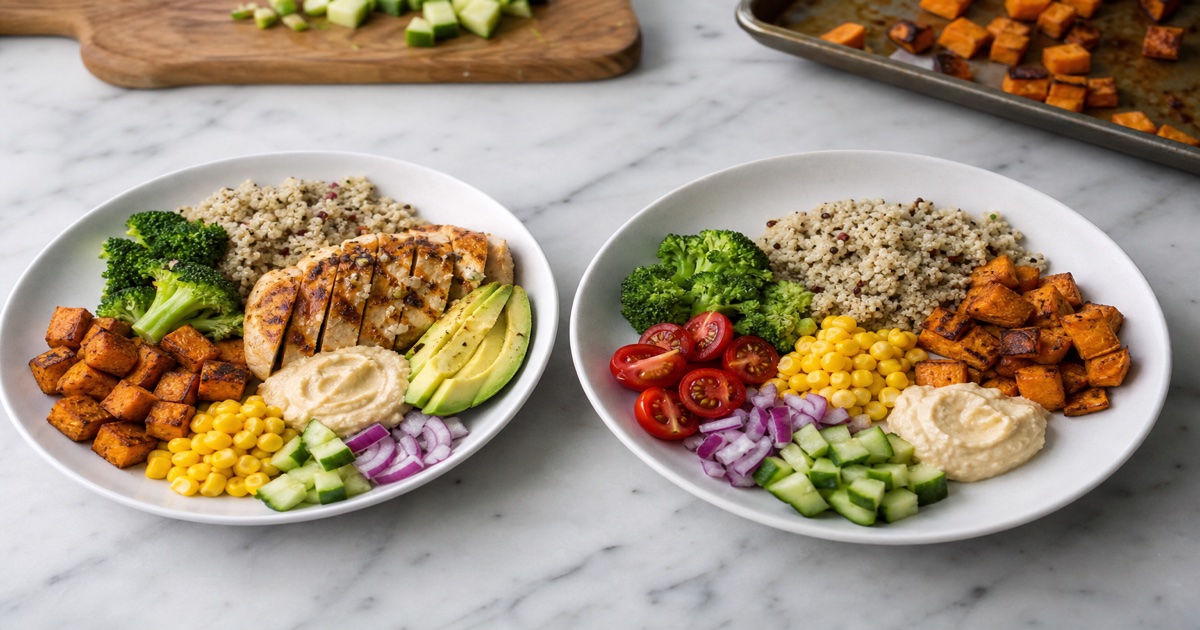
The modular approach works for most diet mismatches:
ChefSphere's diet-aware planning and diet meal plans hub help you keep shopping efficient instead of buying two parallel pantries.
Get started: Create a free ChefSphere account and invite your partner. Both swipe, AI merges, dinner is decided — no nightly debate.

