
You found the apartment. You merged the spice racks. You hung one shelf crooked and called it charming. Then Tuesday arrived, the fridge was half-empty, and neither of you wanted to be the person who "always decides dinner." Welcome to the first month of cohabitation—where Uber Eats feels like a relationship tool and a shared kitchen feels like a pop quiz.
This is not a lecture about becoming meal-prep influencers. It is a 14-day starter plan for two people who want a rhythm before they want a perfect system: who cooks, who shops, what to buy first, and fourteen dinners that will not fight your schedule.
Why the first months feel like delivery apps
Moving in together changes food in ways nobody warns you about. You now share one fridge, one budget, and two different definitions of "we'll figure it out." Without a default, figure it out becomes a nightly negotiation at peak hunger—and negotiation loses to DoorDash almost every time.
The goal for month one is not culinary excellence. It is predictability: enough structure that you eat at home most nights without keeping score, without a Pinterest board, and without pretending you will batch-cook twelve containers on Sunday when you still have boxes to unpack.

Build a rhythm, not a rigid 7-day plan
Most new couples try a perfect weekly grid on day three and abandon it by Thursday. Start with a two-week rhythm instead:
- Three easy solo-cook nights each (20–30 minutes max)
- One shared cook-together night (fun, not efficient)
- One assembly night (wraps, grain bowls, big salads—zero technique)
- Two flexible nights (leftovers, takeout, or friends)
That pattern repeats for fourteen days. You are not failing if Friday becomes pizza; you are failing if every Friday becomes a crisis because nothing was decided by 6pm.
For the full framework on splitting nights fairly, see how couples split cooking fairly—the rotation logic applies from week one.
Who cooks, who shops: the starter split
Cooking is three jobs: deciding, shopping, and making. New couples who try to split all three evenly every day burn out fast. Trade instead:
| Role | Partner A (example) | Partner B (example) |
|---|---|---|
| Planning | Owns the 14-day list | Reviews and vetoes |
| Shopping | One weekly trip | Backup midweek run |
| Cooking | 3 nights/week | 4 nights/week |
Write it on the fridge for two weeks. After day fourteen, look at what actually happened—not what felt fair—and adjust. The point is visible defaults, not permanent roles.
ChefSphere's Couple Zone makes this explicit: cooking assignments, shopping assignments, and a shared plan both partners can see. When "whose turn is it?" is a calendar question, it stops being an argument.
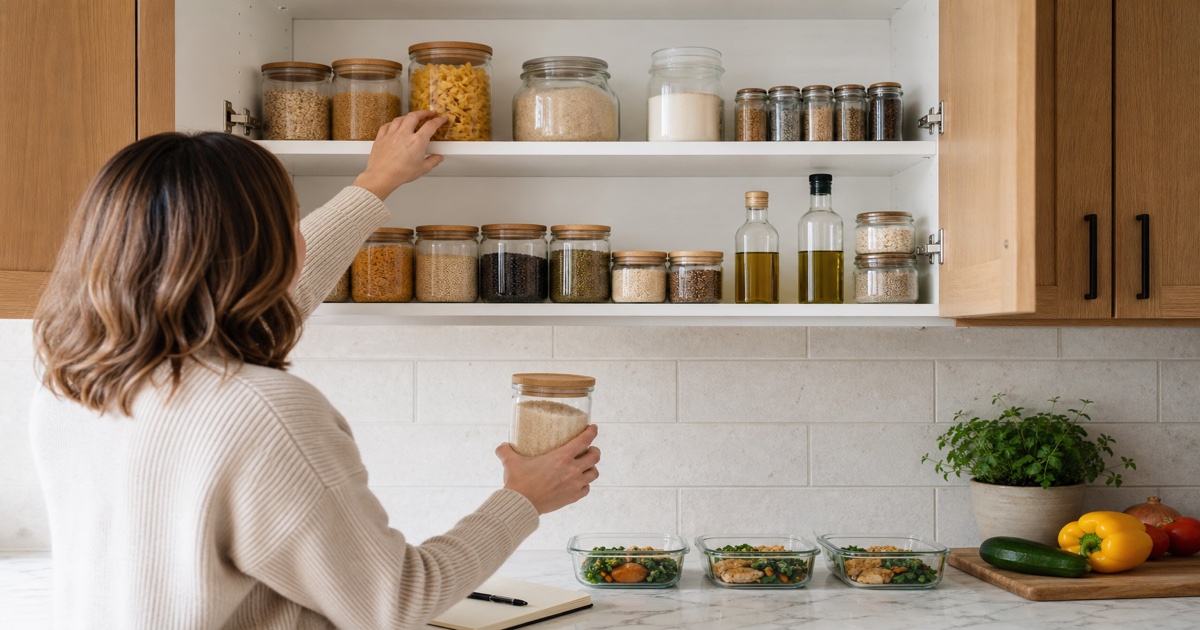
Starter pantry: week one only
Do not buy a full pantry on move-in day. Stock just enough to cook the first seven dinners:
Oils and basics: olive oil, salt, black pepper, garlic (fresh or jarred), red pepper flakes
Grains and carbs: rice, pasta, tortillas or wraps, bread
Pantry proteins: canned beans, canned tomatoes, eggs, one neutral protein (chicken thighs or tofu)
Flavor builders: soy sauce, lemon or lime, Dijon mustard, honey or maple syrup
Freezer backup: frozen peas or mixed vegetables, frozen berries for smoothies
Everything else—fresh herbs, specialty spices, the air fryer attachment—can wait until you know what you actually cook.
Your first shared grocery list
Before the first big shop, agree on three rules:
- One list, one source of truth — not two notes apps that never sync
- Shop from the plan — if it is not on this week's dinners, it does not go in the cart (snacks excepted; be human)
- Overlap on purpose — the same bag of spinach covers Tuesday salad and Thursday pasta; half an onion from Monday tacos goes into Wednesday stir-fry
Here is a grouped starter list for week one (adjust portions for two):
Produce: onions, garlic, lemons, salad greens, bell peppers, broccoli, avocados, bananas
Protein: chicken thighs or tofu, ground turkey or black beans, eggs, Greek yogurt
Dairy: shredded cheese, butter or plant butter, milk or oat milk
Pantry restock: pasta, rice, canned tomatoes, tortillas, olive oil if low
Frozen: peas, berries
Tie the list to meals, not vibes. That is what separates meal planning for two from a shared note that says "get stuff for dinner."
14-day dinner plan: week 1
These are formats, not recipes—swap proteins and sauces based on what you like. Browse recipes when you want specifics; the structure is what matters first.
| Day | Dinner | Cook | Notes |
|---|---|---|---|
| Mon | Pasta with garlic, olive oil, and greens | Partner B | 20 min; uses pantry pasta + frozen peas |
| Tue | Chicken (or tofu) stir-fry over rice | Partner A | One pan + rice; soy sauce + frozen veg |
| Wed | Taco night | Partner B | Ground turkey or beans; leftover toppings → Thu lunch |
| Thu | Big salad + rotisserie or grilled protein | Assembly | Fastest night; no stove required |
| Fri | Cook together: homemade pizza or flatbreads | Shared | Buy dough or use tortillas; make it fun |
| Sat | Sheet-pan chicken thighs, potatoes, broccoli | Partner A | One tray; leftovers for Sun lunch |
| Sun | Leftover remix bowls | Flexible | Strategy night: plan week 2, scan the fridge |
14-day dinner plan: week 2
Repeat the rhythm with new flavors so you learn overlap without boredom:
| Day | Dinner | Cook | Notes |
|---|---|---|---|
| Mon | Grain bowls (rice, protein, veg, sauce) | Partner A | Same rice pot as week 1; new sauce |
| Tue | Shakshuka or egg skillet with bread | Partner B | Eggs + canned tomatoes; one pan |
| Wed | Wraps (fajita-style or Mediterranean) | Partner B | Uses leftover veg from Mon/Tue |
| Thu | Soup + salad | Partner A | Canned tomatoes + beans; blender optional |
| Fri | Takeout or friends | Flexible | Planned indulgence beats guilt |
| Sat | Cook together: curry or chili | Shared | Big batch; freeze half if you can |
| Sun | Pantry pasta or fried rice | Flexible | Use what's left; shop for week 3 |
After fourteen days you will know your real patterns: who is faster at chopping, which nights need assembly, and whether you need more or fewer cook-together nights.
Sequence perishables so nothing dies in the drawer
New shared fridges fail when produce arrives before a plan. Simple sequence:
- Day 1–2: salad greens, herbs, avocados
- Day 3–4: bell peppers, broccoli, fresh protein
- Day 5–7: hardier veg (carrots, cabbage), frozen backup
If greens are wilting on Wednesday, Thursday becomes salad night—even if the plan said soup. Flex within the structure beats throwing away $8 of spinach.
When the plan falls apart (and how to recover)
It will fall apart. Late work, a fight, a friend dropping by, an empty bank account mid-month. Recovery protocol:
- Do not replan the whole month. Pick tomorrow's dinner only.
- Default to assembly — wraps, yogurt bowls, eggs on toast.
- One partner owns the reset — fifteen minutes Sunday to re-anchor the week.
Couples who survive month one are not the ones who never order pizza. They are the ones who return to the rhythm without shame or a spreadsheet audit.
Let ChefSphere run the rotation
By week three you will want the plan, the list, and the assignments in one place. ChefSphere's AI meal planner builds a two-week plan from both taste profiles, assigns cooking nights in Couple Zone, and generates one aggregated grocery list. Swipe through beginner recipes, swap any meal, and the list rebalances.
That is the difference between "we should meal plan" and a system that remembers you hate cilantro and they cannot eat shellfish—without a nightly debate.
Related reading
- Meal planning for two — the full Couple Zone walkthrough
- Meal planning — household planning beyond the starter fortnight
- How couples split cooking fairly — rotation without scorekeeping
- AI meal plan — generate your first shared plan in under a minute
Get started: Create a free ChefSphere account. Tell the AI you just moved in together, swipe through easy dinners for two, and build your first 14-day plan with a shared grocery list in under a minute. Download the app and make night one a plan—not a standoff.


