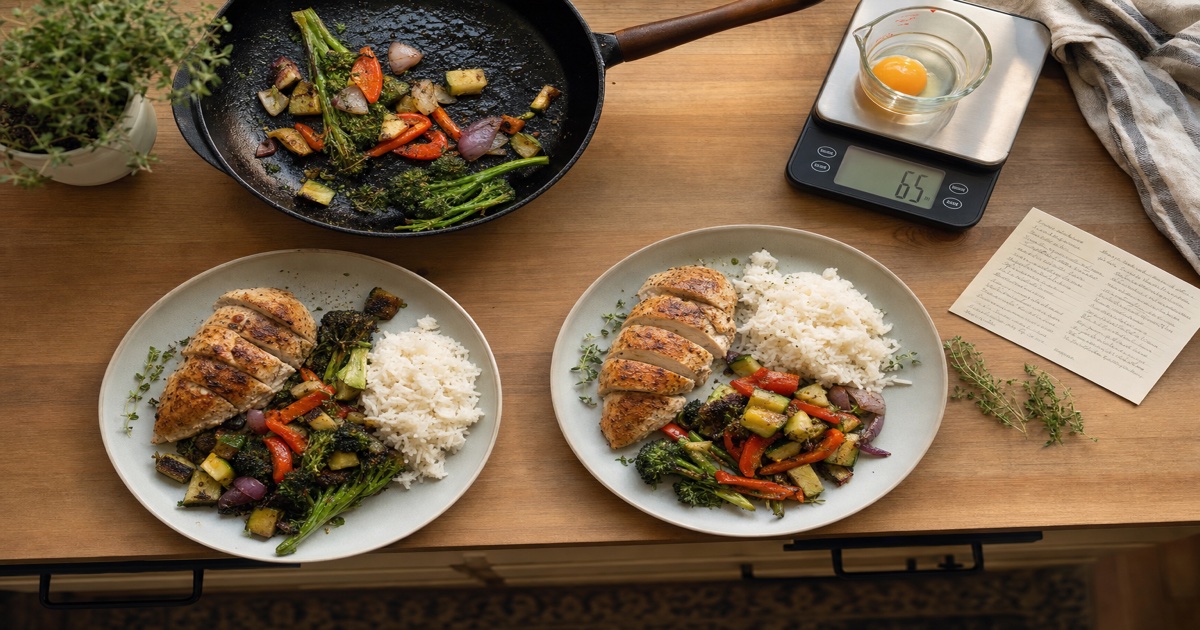
You found a recipe you both love. It serves six. You divide everything by three, cook it anyway, and by Thursday you are eating the same lukewarm pasta bake for the third night in a row — or throwing away what you cannot face again. Cooking for two is not about eating less. It is about cooking the right amount so dinner feels fresh, not like a reheated obligation.
Most recipes assume a family of four or a dinner party. Grocery packages assume the same. The result is a couple's kitchen that either overfeeds or over-wastes. The fix is not guesswork. It is a handful of scaling rules, a portion chart you can memorize, and a plan that treats two servings as the default — not an afterthought.
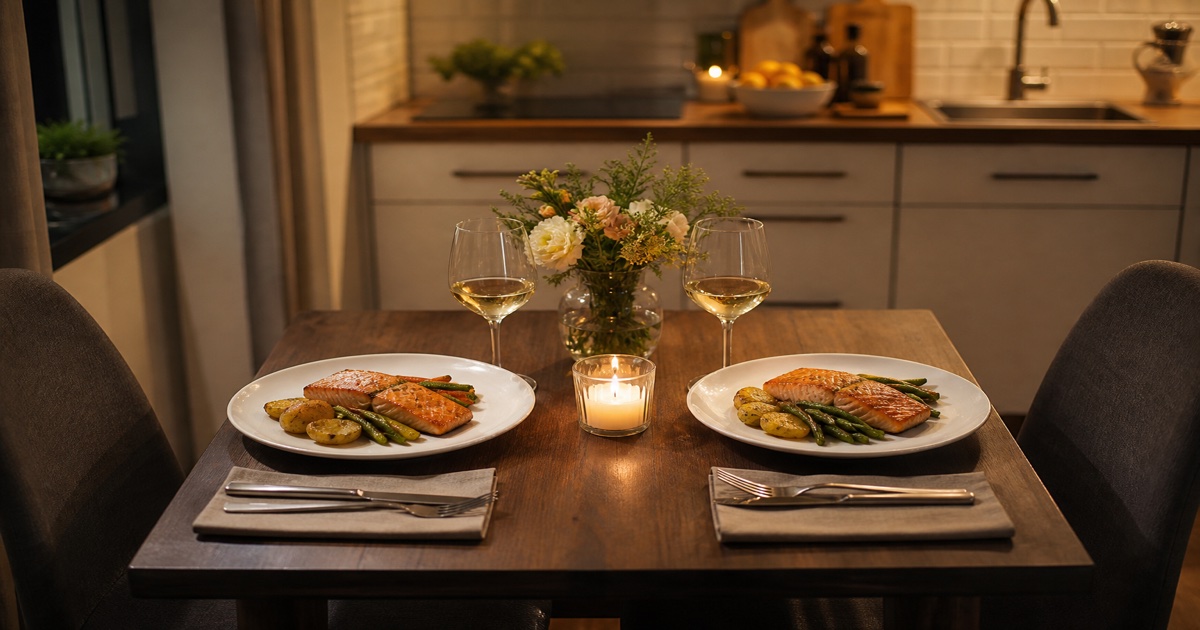
Why couples over-cook (and why halving feels wrong)
The instinct is simple: divide everything by two and call it done. That works for flour and broth. It fails for salt, eggs, baking powder, and anything where depth in the pan changes how heat moves through the food.
There is also a psychological layer. Many couples grew up in households where "enough" meant leftovers for lunch. Cooking exactly two portions can feel stingy — as if you are not being hospitable to yourselves. But a week of unwanted leftovers is not hospitality. It is storage tax: fridge space, guilt, and eventually the bin.
The goal is one satisfying plate each, maybe a small planned portion for tomorrow's lunch — not a cascade of containers you dread opening.
Scaling factor cheat sheet
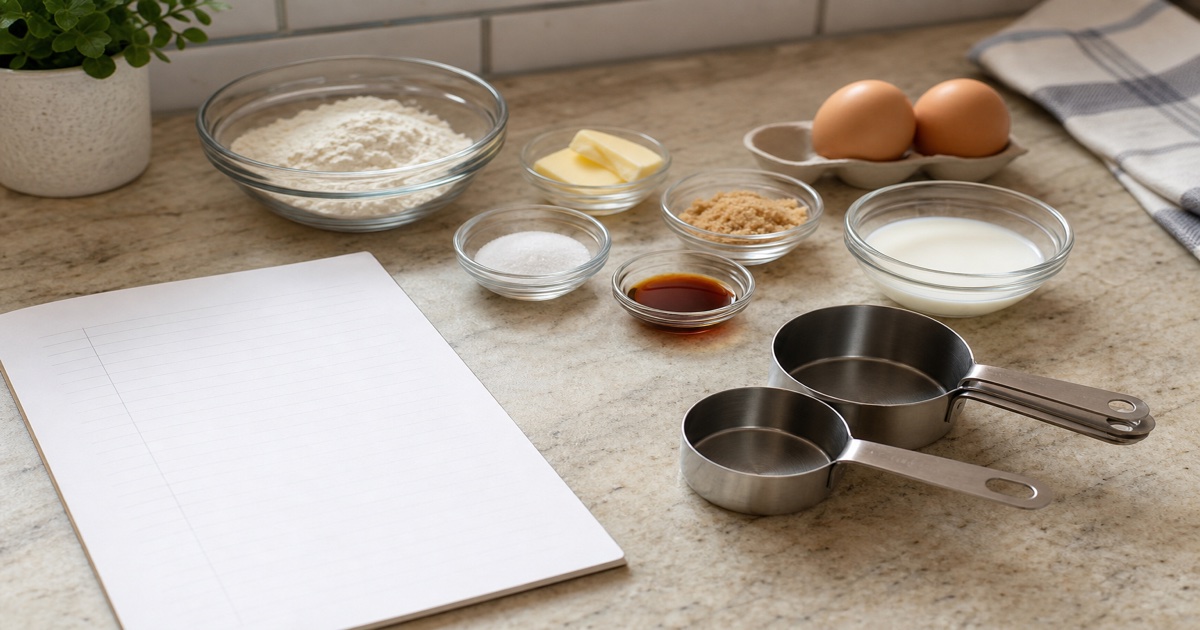
Use this table when converting any recipe to two servings. Multiply the original quantity by the scaling factor.
| Original servings | Scaling factor | Example: 2 cups broth → |
|---|---|---|
| 4 → 2 | × 0.5 | 1 cup |
| 6 → 2 | × 0.33 (⅓) | ⅔ cup |
| 8 → 2 | × 0.25 (¼) | ½ cup |
| 3 → 2 | × 0.67 (⅔) | 1⅓ cups |
| 5 → 2 | × 0.4 | 0.8 cup (roughly ¾ cup + 1 tbsp) |
Tip: For awkward numbers like ⅓ cup, use tablespoons. One cup = 16 tbsp, so ⅓ cup ≈ 5 tbsp + 1 tsp. A kitchen scale removes the math entirely — weigh the full recipe once, then halve by weight.
Exact portion chart for two
These are starting points for a main-dish dinner. Adjust up slightly if you are very active or down if you prefer lighter meals.
| Ingredient | Per person | For two |
|---|---|---|
| Dry pasta | 75 g (2.6 oz) | 150 g |
| Dry rice | 50 g (1.8 oz) | 100 g |
| Chicken breast (boneless) | 90–135 g (3–4.8 oz) | 180–270 g |
| Chicken thigh (boneless) | 100–150 g | 200–300 g |
| Ground meat | 100–125 g | 200–250 g |
| Fish fillet | 120–150 g | 240–300 g |
| Dry lentils | 40–50 g | 80–100 g |
| Potatoes | 150–200 g | 300–400 g |
For pasta, 75 grams per person yields about 1.5 cups cooked — enough for a saucy main without the pot running over. For rice, 50 grams dry makes roughly ¾ cup cooked per person, which pairs well with a stir-fry or curry.
Chicken is the ingredient couples most often overshoot. A single large breast can weigh 250 grams — already more than one person's portion. Weigh it. Split it. Two modest pieces beat one giant piece cut in half after cooking.
Ingredients that do not scale linearly
Some things need judgment, not arithmetic.
Salt, acid, and spice: use 60–75%
Halved recipes need less salt than half the original amount. Start at 60% of the listed salt, taste at the end, adjust. The same applies to lemon juice, vinegar, hot sauce, and concentrated pastes like miso or tomato paste. You can always add more. You cannot subtract.
The half-egg fix
Recipes with one egg are the classic halving trap. Do not try to crack half an egg.
- Whisk the whole egg until yolk and white are fully combined.
- Measure 1.5 tablespoons — that is half an egg.
- Use the remainder within 24 hours (scrambled eggs, a small pancake, a glaze).
For two eggs in the original, use one whole egg. For three eggs, use one whole plus 1.5 tablespoons of a whisked second egg.
Baking powder, yeast, and leavening
Reduce leavening slightly less than proportionally — about 75% when halving. Too much leavener in a small batch makes muffins peak and collapse. When in doubt, err on the side of less.
Garlic and fresh herbs
Garlic scales closer to linear, but fresh herbs can go slightly under half — their flavor concentrates in smaller volumes. Start at 75% and add more if needed.
The pan-size rule: drop one size
Volume matters as much as weight. A halved casserole spread across the original 9×13 pan becomes a thin layer that dries out before the center sets. Drop one pan size:
- 9×13 → 8×8 or 9×9
- 10-inch skillet → 8-inch skillet
- Large Dutch oven → medium saucepan (for stovetop dishes)
The food should sit at roughly the same depth as the original recipe intended. If it looks too shallow, shorten the cooking time and watch closely.
Cooking time: smaller does not mean half the time
This catches everyone. A halved roast chicken still needs nearly the same time to reach safe internal temperature — the mass per piece is similar if you bought two small pieces instead of one large one. But a halved brownie batter in a smaller pan may bake 5–15 minutes faster.
Rules of thumb:
- Proteins: Use a thermometer. Chicken breast: 74°C / 165°F. Do not rely on the original timer alone.
- Baked pasta and casseroles: Check 10 minutes before the recipe says done.
- Soups and stews: Simmer time stays similar; you are mainly reducing liquid volume.
- Sautés and stir-fries: Cook faster — less food in the pan means quicker browning. Lower heat if things are burning before they are done.
Recipes that should not scale down
Some dishes resist small batches:
- Whole roast chicken or turkey — buy parts instead (two thighs, two drumsticks).
- Large-format bread — halving yeast dough is fussy; freeze half the loaves or choose a small-batch recipe.
- Slow-cooker "dump" meals — many slow cookers need minimum fill levels; use a smaller pot or stovetop method.
- Recipes built on one large piece (whole fish, crown roast) — switch to fillets or a different recipe.
When a recipe is fundamentally designed for a crowd, adapt the format, not just the numbers.
Build a two-person default
The couples who cook without leftover fatigue share three habits:
- Weigh staples once — pasta, rice, protein — until the portions become muscle memory.
- Plan one optional lunch portion, not four backup dinners.
- Keep a "scale card" on the fridge — the table above, laminated or taped, until you no longer need it.
For a full framework on planning meals as a pair — shared lists, overlap ingredients, and budget — see our guide to meal planning for two.
How ChefSphere auto-scales for two
Doing the math every night gets old. ChefSphere's AI meal plan treats two servings as a first-class setting:
- Recipes scale automatically — portions, grocery quantities, and prep notes adjust together.
- Ingredient reuse across the week — the half-bag of spinach from Monday's recipes becomes Wednesday's side, not a science experiment in the crisper.
- Budget-aware shopping — real local prices from Community Prices keep scaled-down lists from creeping back up to family-size totals.
- Couple Zone — both partners swipe preferences; the plan finds overlap without doubling quantities.
Set household size to two once. Every plan after that respects it — no more dividing a six-serving stew and hoping the math worked.
Related reading
- Meal Planning for Two on a Budget — Overlap-first planning that cuts waste before you scale a single recipe
- Meal Planning for Couples — Shared systems when both partners cook
- Spring 2026 Meal Plan — A seasonal framework you can scale to two
- Best Meal Planning Apps 2026 — Compare tools that handle portion scaling
Get started: Create a free ChefSphere account or download the app. Set your household to two, swipe a week of dinners, and let the AI scale every recipe — portions, pans, and grocery list included.


