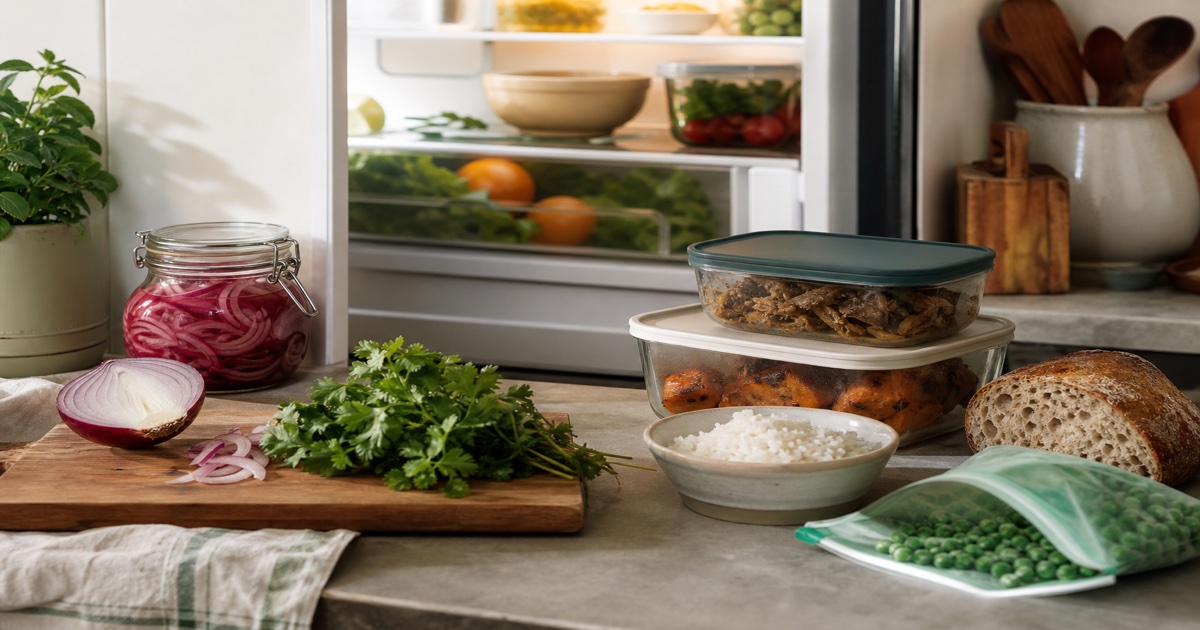
The crisper drawer tells the story. Half a bell pepper going soft. A quarter head of cabbage in a plastic bag nobody remembers opening. Fresh herbs that cost three dollars and lasted one recipe. Cooking for two should mean buying less — but in practice, two-person kitchens often waste more per person than families of four, because every package and produce bag is sized for someone else.
The problem is not carelessness. It is a system built for four that you are navigating as two. The fix is not willpower. It is planning that treats partial ingredients as normal, not emergencies — bridge ingredients, planned-overs, and a rescue playbook for the half-onion moments every couple knows.
Why two-person kitchens waste produce
Family-size recipes create family-size leftovers — but couples face a different waste pattern. You buy a bag of spinach for one salad. You use half. The rest melts into sludge. You need one carrot; the bag has eight. You grab an onion; the other half sits cut-side-down on a shelf, drying out.
Grocery retail makes this worse. Pre-packed produce is often cheaper per unit than loose — but only if you use all of it. For two, the "deal" on a five-pound bag of potatoes is a deal only if you eat potatoes five nights in a row.
The waste is not just money. It is the low-grade friction of opening the fridge and feeling guilty before you have even decided what is for dinner. A zero-waste approach for couples is really a coordination problem: making sure every partial ingredient has a next appointment.
Rule 1: Bridge ingredients — two jobs each
A bridge ingredient appears in at least two meals during the week. It connects Monday to Wednesday so nothing dies in between.
Examples:
- One bunch of cilantro → Monday tacos, Wednesday grain bowl, Friday egg scramble
- One lemon → Tuesday fish, Thursday salad dressing, Saturday gin and tonic (optional but morale counts)
- Half a block of feta → Tuesday salad, Thursday stuffed peppers
- One can of coconut milk → Monday curry, Wednesday smoothie (yes, really — freeze the remainder in an ice cube tray)
When you build your plan, list bridge ingredients first. If an ingredient only has one job, either give it a second job or buy the smallest format possible — a single loose pepper instead of a three-pack.
The meal planning for two framework in ChefSphere's Couple Zone is built around this overlap logic. The AI looks for ingredients that span multiple meals before suggesting anything single-use.
Rule 2: Planned-overs, not leftovers
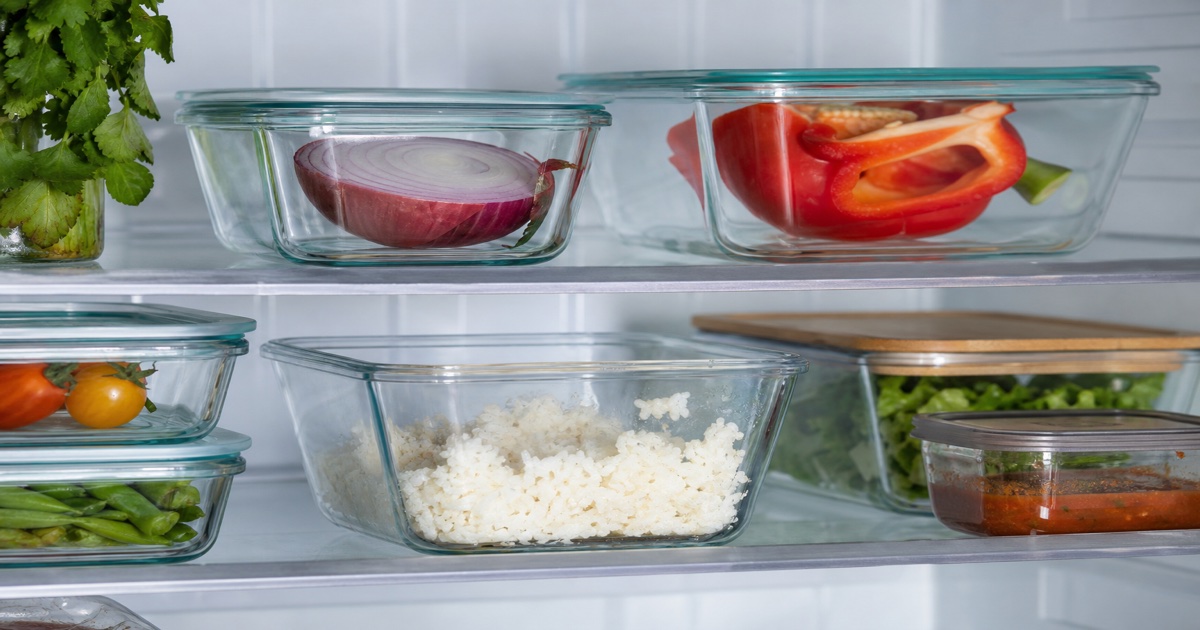
Language matters. Leftovers are what happens when you cooked a six-serving lasagna and now you are punishing yourselves. Planned-overs are deliberate: you roast two chicken thighs on Monday because Wednesday's salad needs sliced protein. You cook 1 cup of extra rice because Friday's fried rice depends on it.
The difference is on the plan. Planned-overs show up on the calendar with a name — "Wednesday: chicken salad (uses Monday thighs)" — not as a vague container labeled "???" in the back of the fridge.
For couples, one or two planned-over portions per week is the sweet spot. Enough to save a cooking night. Not enough to feel like you never eat anything fresh.
Rule 3: Shop in shelf-life order
Use delicate produce early in the week. Save hardy vegetables for later.
| Eat first (days 1–2) | Mid-week (days 3–4) | Lasts the week |
|---|---|---|
| Fresh herbs, salad greens, berries | Broccoli, mushrooms, zucchini | Carrots, cabbage, onions, potatoes |
| Fish and shellfish | Chicken, ground meat | Eggs, hard cheese, tofu |
| Avocado, ripe tomatoes | Bell peppers, cucumbers | Winter squash, apples |
When you shop, physically sort the bag in this order. Put the herbs where you will see them — not buried under the cabbage that will outlive them.
An AI meal plan that sequences meals by ingredient fragility does this sorting for you. Delicate greens land on Monday and Tuesday; the cabbage stir-fry waits until Thursday.
Rule 4: Buy two-person quantities
Stop shopping like a family of four and eating like a couple.
Practical swaps:
- Protein: Buy two pieces, not a family pack — two thighs, two fillets, 250 g ground meat.
- Produce: Choose loose over pre-packed when you only need one or two.
- Dairy: Small containers of cream, sour cream, and yogurt unless you have three planned uses.
- Herbs: A live pot of basil on the windowsill beats a cut bunch that dies in 48 hours.
- Bread: Freeze half the loaf on day one if you cannot finish it by day three.
Check unit prices, but optimize for what you will use, not what looks cheapest on the shelf tag. A $4 bag you throw half away is more expensive than $2 loose that you eat entirely.
Half-ingredient rescue cheat sheet
When you are stuck with a partial ingredient and no plan, reach for this table.
| Half ingredient | Rescue move | Ready in |
|---|---|---|
| Half onion | Quick-pickle with vinegar + salt; or freeze diced (cook from frozen, do not thaw) | 10 min / freeze |
| Half bell pepper | Slice and store; fajitas, omelette, or stir-fry within 3 days | 15 min |
| Half lemon | Juice and freeze in ice cube tray; zest dries — use today on pasta or salad | 5 min |
| Half can tomatoes | Freeze flat in a bag; perfect for next week's soup | 2 min |
| Half bunch herbs | Blend with oil = herb oil for the week; or chop and freeze in butter | 10 min |
| Half avocado | Lemon juice on cut surface, wrap tight, eat tomorrow; or mash into dressing | — |
| Half cabbage | Shred for slaw (lasts 4 days dressed) or quick sauté side | 15 min |
| Half bag spinach | Wilt into eggs tonight — do not wait | 10 min |
The rule: assign a job within 48 hours or preserve (freeze, pickle, oil) on the day you open the package.
Three use-it-up formats
When the fridge has odds and ends but no clear meal, these three formats absorb almost anything.
The bowl
Grain base + protein + whatever vegetables need using + sauce. Rice, farro, or quinoa underneath; leftover chicken, a fried egg, or chickpeas on top; the sad pepper and the last of the cucumber diced in. Sauce ties it together — tahini-lemon, peanut-lime, or yogurt-herb.
The frittata
Eggs hold the universe together. Half an onion, wilting spinach, half a pepper, last scraps of cheese — sauté, pour beaten eggs over, finish in the oven or covered on the stovetop. Serves two for dinner or one dinner plus lunch.
The soup
Broth + aromatics + whatever. Half an onion, one carrot, the remaining cabbage, a can of beans, pasta broken in half. Soups forgive imprecise quantities and improve with the odd half-portion floating in.
Keep these three in your back pocket and the "we have nothing to eat" moment becomes a 20-minute project instead of a delivery app order.
Browse recipes filtered by ingredient when you want something more structured — but the bowl, frittata, and soup trinity handles most rescue nights.
How ChefSphere circulates ingredients
Manual tracking works until life gets busy. ChefSphere automates the circulation:
- Ingredient threading — The AI places the same ingredient across multiple meals in the week before adding new items to the list.
- Expiry-aware suggestions — Scan your pantry or fridge; get recipes ranked by what needs using first.
- Aggregated grocery list for two — Quantities match the plan, not a family-size default. No more half-used bags.
- Couple Zone sync — Both partners see the same plan and list. Nobody buys a second onion because they did not know half of one was already in the fridge.
The goal is a fridge where opening the door feels like options, not archaeology.
Related reading
- Meal Planning for Two on a Budget — Waste reduction is the hidden budget hack for couples
- How to Cook for Two Without Leftovers — Portion scaling so you produce less waste in the first place
- Meal Planning for Couples — Shared planning systems that keep both partners aligned
- Grocery Budget 2026 — What couples actually spend and where waste hides
Get started: Create a free ChefSphere account or download the app. Build a two-person plan that circulates every ingredient — so the half-onion always knows where it is going next.


